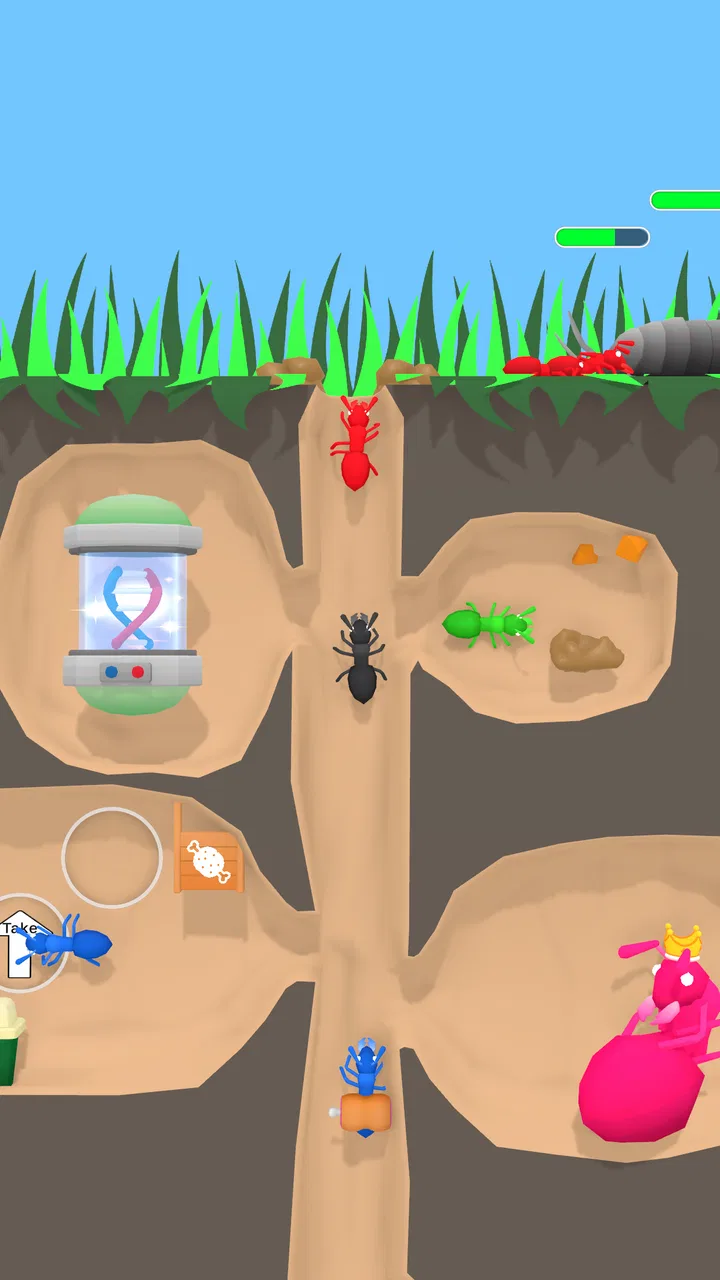
Empire of Ants - Idle Game
- 4.7
- Rating
- 10.00M
- Installs
- Free
- Price

 Analysis by App-foxy
I spent time with Empire of Ants - Idle Game as a casual simulation game, paying particular attention to how comfortably its colony-building loop works in different situations. The basic idea is easy to understand: guide an expanding ant population, collect resources, improve the colony, and let automation handle more of the routine work. That simplicity is the game’s biggest advantage, but it also means the experience depends heavily on whether you enjoy gradual progress rather than constant action.
Gamincat has made a free game that is approachable from the first session. It is rated for Everyone, runs on Android 7.0 or later, and has reached more than five million installs. Its average score is 4.6 from roughly sixty thousand ratings, which fits my impression that the game appeals strongly to players who want a low-pressure management experience. There are in-app purchases ranging from $0.99 to $104.99 per item, so the free entry point is attractive, but spending decisions deserve attention as the colony grows.
How clearly the colony is presented
I look at this section through a practical question: can I tell what the colony needs without turning a quick visit into a study session? The answer depends partly on how comfortably I read its icons and resource changes, so I’ll also consider how a simple check-in can stay manageable as the colony grows.
You May Also Like

 Blood Strike: 2.5 Anniversary
Blood Strike’s Loadouts Turn Every Drop Into a Tactical Gamble
A close look at Blood Strike’s custom loadouts: how fast access to signature weapons reshapes its battle royale rhythm, rewards preparation, and narrows the gap between fights.

 Pandora - Music & Podcasts
Pandora’s Music Is Easy to Start, but Harder to Recover
Pandora’s strength is its low-effort path from a seed to a station. Its weak spot is how much confidence it asks you to place in connection, setup, and quiet recovery.

 8 Ball Pool
 Is Built on Rivalries, Rematches, and Routine
A close look at the rivalries, rematches, shared routines, and unanswered safety questions that turn a quick pool match into a persistent mobile community.

 Samsung Music
’s Quiet Strength Is Playing What You Already Own
Its reach comes less from spectacle than from dependable access to a personal library. That simplicity is both the app’s strongest retention engine and its ceiling.

 AccuWeather: Weather Radar
AccuWeather Review: A Quick, Clear Forecast for Everyday Decisions
For everyday plans, the best forecast is the one you can understand quickly. AccuWeather makes rain timing, radar, and local conditions easy to act on, with a few trade-offs.

 Hill Climb Racing
Why Hill Climb Racing Still Turns Crashes Into One More Run
A tiny car, a bumpy hill and one more upgrade: Hill Climb Racing keeps resurfacing because its simple chaos makes every near-miss feel personal.
More From Our News Desk



Readable goals and a gentle learning curve
The first thing I noticed was how quickly the central loop becomes understandable. You are not asked to learn a complicated economic model before seeing results. Digging and gathering give the colony a clear sense of movement, while upgrades provide obvious reasons to keep checking back. For someone new to idle simulation games, this is far less intimidating than a strategy title filled with menus, competing factions, and long tutorials.
The ant theme also helps with orientation. Resources, workers, expansion, and automation all feel connected to the same idea, rather than being unrelated systems placed beside one another. I could usually tell what I was working toward without needing to remember a long chain of instructions. That matters for players who prefer short sessions or who find dense interfaces tiring.
Navigation is at its best when the game keeps the next useful action visible. I found it natural to check the colony, collect what had accumulated, and decide whether the next improvement should support faster gathering or broader growth. This creates a simple routine that is easy to repeat. It is a good fit for a player who wants structure without having to plan every minute.
Where readability can become less comfortable
The same compact presentation that makes the game approachable can make it less comfortable when several pieces of information compete for attention. A player who has difficulty distinguishing small icons, reading compact labels, or interpreting changes through color alone may need more time to understand what has changed since the last visit. I did not find the experience difficult in a strategic sense, but visual clarity becomes more important as the colony develops and more upgrade choices appear.
This is also a game where progress can feel quieter than the interface suggests. Numbers and resource indicators may change frequently, yet the practical difference between two upgrades is not always immediately obvious. I recommend pausing before spending accumulated resources and checking what the improvement actually changes. That small habit prevents the common idle-game mistake of buying the most visible option instead of the one that best supports your current bottleneck.
For players who use a larger phone or tablet, the overall colony view may feel easier to inspect than it does on a compact screen. On a smaller display, I would play with the device held steadily and avoid rushing through upgrade choices. The game rewards a deliberate rhythm, so there is little benefit in tapping quickly simply because several controls are available.
A useful routine for players who lose track easily
One practical approach is to give each visit a purpose. I might begin by checking whether gathering is limiting expansion, then review the available improvement, and only afterward collect or spend resources. This turns a potentially scattered session into a three-step check. It is especially useful for players who return after a break and need a quick way to rebuild their sense of what the colony needs.
I also found it helpful to avoid treating every notification or newly available action as urgent. Idle games can create a feeling that something must always be claimed immediately, but this colony works better when I consider the next upgrade as part of a longer sequence. The game is more relaxing when I let automation do its job instead of constantly supervising every small change.
Controls, sensory comfort, and different play contexts
I’m also weighing how the game feels beyond its basic management loop, including the difference between calm, deliberate taps and a screen that may feel busy on a smaller device. That matters because a game can be easy to understand yet still suit some hands, eyes, and play settings better than others.
Low physical demand, with some important exceptions
The game does not ask for the rapid reactions associated with an action game. Most of my interaction involved ordinary taps, selecting improvements, and checking the colony’s progress. That makes it suitable for players who prefer a slower pace or who cannot comfortably manage repeated fast gestures. There is no need to memorize complex button combinations or coordinate several actions at once.
That does not mean every player will find it equally effortless. Repeated tapping can still become uncomfortable during longer sessions, particularly if someone is sensitive to small touch targets or has limited precision. My advice is to play in short visits rather than trying to force a long optimization session. The idle structure supports that approach naturally, and it reduces the physical strain that can come from repeatedly collecting and upgrading.
Players with tremors or reduced motor accuracy may want to use a stable grip and make one deliberate selection at a time. The game’s slower decision-making helps, but it does not remove the need to hit the intended control. I would not choose this as a substitute for a fully hands-free experience, because progression still depends on interacting with the screen.
Visual and sensory considerations
The ant-colony setting gives the game a busy, active feel, but it is not built around startling action or demanding reflexes. That makes it easier to fit into calm moments than a combat-heavy simulation. I could check progress while relaxing, during a short break, or while listening to something else, although I would still keep enough attention available to read upgrade information before confirming a purchase.
Players who are sensitive to motion, animation, or visual clutter should judge the game by a short personal trial rather than assuming that a simple management loop will automatically feel quiet. Even an uncomplicated colony can involve movement, changing resource states, and repeated visual feedback. If I were introducing it to someone with sensory sensitivities, I would recommend beginning with brief sessions and stopping as soon as the screen starts to feel busy.
Sound is not central to understanding the colony’s progression, which is helpful in shared spaces or situations where audio is inconvenient. I could follow the basic management loop through the visual presentation. That makes the game more flexible than a title that communicates important information mainly through sound, though players should still pay attention to how comfortable the visual feedback feels on their own device.
Why the idle format helps with attention
The strongest accessibility-related quality here is the ability to step away without abandoning the whole experience. Instead of demanding continuous concentration, the game lets the colony represent progress over time. I found that useful when my attention was divided: I could leave the game, return later, and resume from a familiar management point rather than restarting a difficult sequence.
However, this benefit comes with a trade-off. The game can become repetitive if you need frequent novelty or if you prefer goals that change dramatically from one session to the next. Automation reduces effort, but it also reduces the amount of direct control. Players with attention difficulties may appreciate the predictable routine, while players who need constant stimulation may find the same routine too passive.
Using the game in everyday situations
For me, the most useful test is whether the colony fits into ordinary spare moments without demanding constant attention. I’ll look at a short check-in as a small routine, then consider when it makes more sense to put the phone away and return when I can focus on a choice.
A realistic short-session example
Imagine having ten minutes before leaving for work or school. I would open the colony, see which resource has accumulated, and decide whether the next improvement should make gathering more efficient or support expansion. After making that choice, I could close the game without feeling that I had missed a time-sensitive action requiring fast reflexes. That is where the game feels most convincing: as a small, repeatable activity rather than a demanding appointment.
It also works during a quiet evening when I want something to do with my hands but do not want a complicated story or competitive match. I can make a few decisions, watch the colony develop, and stop when the session begins to feel repetitive. The ability to end at a natural point is valuable for players who need flexible pacing.
On the other hand, I would avoid treating it as a game to play while walking, commuting in a crowded vehicle, or doing another task that requires full attention. The low-pressure design does not make the screen safe to ignore. A missed tap is not a disaster, but divided attention can still lead to careless spending or confusion about which improvement was selected.
Who will get the most from it
I would recommend this game to someone who enjoys watching a system grow gradually. It is particularly suitable for players who like resource collection, light planning, and the satisfaction of unlocking a more efficient routine. It is also a friendly starting point for anyone curious about simulation games but put off by complex city builders or management titles that begin with too many rules.
It may suit families looking for an Everyone-rated game with a nonviolent theme, although younger players may still need guidance around optional purchases. The ant setting is easy to understand, and the colony concept gives the progression a clear identity. I would explain that the free download does not mean every possible shortcut is free, especially if a child is using a shared device.
I would skip it if you want direct control over every worker, detailed construction planning, or a strong narrative campaign. Compared with a traditional city-building simulation, this game is lighter and more automated. Compared with a competitive strategy game, it offers less pressure and fewer dramatic reversals. Its appeal is not depth through complexity; it is the calm satisfaction of steady development.
How it compares with other idle games
Many idle games rely on increasingly large numbers and a cycle of collecting, upgrading, and repeating. This one stands out mainly because the ant colony gives that cycle a concrete setting. Digging, gathering, and automation feel like parts of one ecosystem rather than abstract buttons in a spreadsheet. That theme makes the routine easier for me to follow, even when the underlying activity remains familiar.
The trade-off is that players who already have several idle games may not find the basic loop radically different. The colony presentation adds personality, but it does not automatically solve the genre’s main weakness: progress can become predictable. If you need constant strategic surprises, a deeper management game may be a better use of your time. If you want a softer, more readable entry point, this is the stronger choice.
Remaining barriers and spending decisions
I’ll finish by looking at the friction that can remain even in a low-pressure idle game: repetition, touch interaction, and the temptation to pay to move faster. Thinking through those trade-offs helps me distinguish a genuinely useful shortcut from spending that simply cuts short the patient pace some players enjoy.
Automation is helpful, but not total freedom
Automation is central to the experience, yet I would not describe the game as completely passive. Returning to review progress and choose improvements remains part of the fun. That balance works for me because it gives the colony a sense of direction without requiring constant supervision. Still, anyone expecting to start the game once and never interact again may be disappointed.
The main friction is repetition. Once the best next step feels obvious, the decision-making can narrow into a predictable routine. I found that the game was most enjoyable when I treated each session as a quick check rather than trying to squeeze maximum efficiency from every resource. Players who enjoy optimization may appreciate comparing upgrade paths, but those who dislike repeated menus may lose interest sooner.
Free access and optional purchases
The game is free to download, which makes it easy to try without committing money at the beginning. Optional purchases are priced from $0.99 to $104.99 per item, a wide range that deserves a careful look before confirming anything. I would recommend playing long enough to understand the natural pace of the colony before deciding whether a shortcut is genuinely useful.
My own rule with this type of game is simple: never buy an improvement merely because the game has made waiting feel uncomfortable. First identify the actual obstacle. If gathering is slow, an item that addresses gathering may make sense; if the problem is simply wanting the next milestone immediately, spending may only shorten a satisfying part of the experience. This distinction is especially important for younger players or anyone managing a tight budget.
Version and device expectations
The current version is 0.3.7, and the game supports Android 7.0 and newer. That broad operating-system requirement makes it available to people using older compatible phones, although the comfort of the experience will still depend on screen size, touch accuracy, and how clearly each device displays the colony. A larger screen may help with visual inspection, while a compact phone may be more convenient for quick check-ins.
I would also keep the game updated when possible, not because every player needs the newest device, but because simulation games benefit from ongoing refinement. When a title is still identified by a relatively early version number, I approach it as a game that may continue to change in feel and balance. That is not a reason to avoid it, but it is a reason to remain flexible about the exact rhythm of progression.
My inclusive verdict
After using it as both a quick-break game and a slower evening activity, I see Empire of Ants - Idle Game as an approachable colony simulator with a clear audience. It is easiest to recommend to people who want gentle resource management, simple touch interaction, and progress that continues without demanding constant attention. The ant theme gives familiar idle mechanics enough character to make the routine feel purposeful.
Its strongest inclusive quality is flexibility of time. You can engage for a short visit, step away, and return without needing fast reactions or a perfect memory of a complicated strategy. The main limitations are equally clear: the screen may become less comfortable for players who struggle with small visual details, repeated tapping can still cause physical fatigue, and the gradual loop will not satisfy everyone.
I would recommend starting slowly, checking one resource problem at a time, and treating purchases as optional rather than necessary. That approach lets the free experience show whether its pace suits you before money enters the decision. For players who want a calm, accessible-feeling introduction to idle management, Gamincat’s game is worth trying. For players seeking deep construction tools, dramatic competition, or constant novelty, another simulation will probably be a better match.
Overall, the game earns its appeal through clarity and low pressure rather than complexity. It does not remove every possible barrier, and it cannot promise the same comfort for every player or device. But when played in short, deliberate sessions, it offers a welcoming way to build a small digital colony and watch steady decisions turn into visible growth.
FAQs for Empire of Ants - Idle Game
01What is the main objective of Empire of Ants - Idle Game?
Empire of Ants - Idle Game is designed to simulate the life of an ant colony. The main objective is to build and manage your own ant empire by gathering resources, expanding territories, and upgrading your colony to become the most powerful in the insect world. Players must strategize to ensure the survival and growth of their colony.
02Is Empire of Ants - Idle Game free to play?
Yes, Empire of Ants - Idle Game is free to download and play on both Android and iOS devices. However, it contains in-app purchases that allow players to buy resources, skins, or other bonuses to enhance their gameplay experience. These purchases are optional and not necessary to enjoy the game fully.
03How does the idle gameplay work in Empire of Ants?
The idle gameplay feature allows your ant colony to continue gathering resources and progressing, even when you’re not actively playing. This means players can step away from the game and return later to find their colony has grown and collected resources automatically, providing a relaxed and ongoing gaming experience.
04What kind of strategies can players use to succeed in Empire of Ants?
Players can utilize various strategies, such as optimizing resource management, prioritizing upgrades for efficiency, and carefully planning colony expansions. It’s important to balance short-term gains with long-term growth, ensuring that your ant empire remains sustainable and competitive against rival colonies.
05Are there any social features in Empire of Ants - Idle Game?
Yes, Empire of Ants includes social features that allow players to connect with friends or other players. You can join alliances, compete in leaderboards, and participate in events to earn rewards. These social interactions add an extra layer of engagement and competition to the game.
Pros
- Engaging gameplay with strategic depth.
- Visually appealing ant colony design.
- Frequent updates with new features.
- User-friendly interface and controls.
- Offline play available for convenience.
Cons
- In-app purchases can be pricey.
- Ads can interrupt gameplay experience.
- Requires frequent resource management.
- Initial learning curve for new players.
- Limited customization options for colonies.

Empire of Ants - Idle Game
Gallery